
Table of Contents
- Why Unique Artistic Posters Transform Your Space
- How to Style Pop Culture Posters in Any Room
- Best Gallery Wall Layout Ideas for Artistic Posters
- How to Frame Posters Professionally
- Art Styles and Movements Trending in 2026
- Maintenance and Preservation of Wall Art
- Unique Artistic Posters for Every Budget and Space
Last Updated: August 21, 2026
Why Unique Artistic Posters Transform Your Space
Unique artistic posters do more than fill wall space, they reshape how a room feels. According to IMARC Group’s 2026 Canada Home Decor Market analysis, the home decor market is projected to reach CAD 22.7 billion by 2034, with wall art commanding an increasingly significant share. The personalized home decor segment expands at 7.2% annually as homeowners recognize their walls reflect their identity.
Research from CanadaHelps and Ipsos shows that Canadians who engage regularly with arts and culture are 46% more likely to report excellent mental health. Your walls are an investment in how you experience your space daily.
The challenge isn’t finding posters, it’s finding unique ones that reflect your actual taste instead of mass-produced trends. This guide walks you through selecting, styling, and preserving artistic posters that transform your home into an authentically personal space.
Wall art accounts for 45% of personalized home decor purchases, and the market grows faster than traditional home furnishings as consumers prioritize individual expression over generic aesthetics.
How to Style Pop Culture Posters in Any Room
Pop culture posters work best as statement pieces. Anchor a room around the poster’s mood and color palette rather than hanging it as an afterthought.
Identify the poster’s dominant colors and mood. A vibrant retro gaming poster demands warm, energetic surroundings, burnt orange, deep purple, or rich cream tones with vintage-inspired furniture. A minimalist design needs breathing room and neutral walls to shine.

Layer supporting elements carefully. If your poster features bold graphics, keep surrounding decor simple, one or two complementary pieces, not five competing textures. A single strong poster often outperforms a wall cluttered with multiple pieces. Pair your poster with grounding furniture like a low-profile console table or sleek shelving beneath it.
Lighting transforms how a poster reads. Warm overhead light softens bold graphics and prevents glare. For textured or metallic elements, consider a dedicated picture light that highlights details without overwhelming the space.
:::pro-tip
Pop culture posters paired with solid-colored throw pillows in one accent color from the poster create instant cohesion, tying the room together without looking staged.
:::
Best Gallery Wall Layout Ideas for Artistic Posters
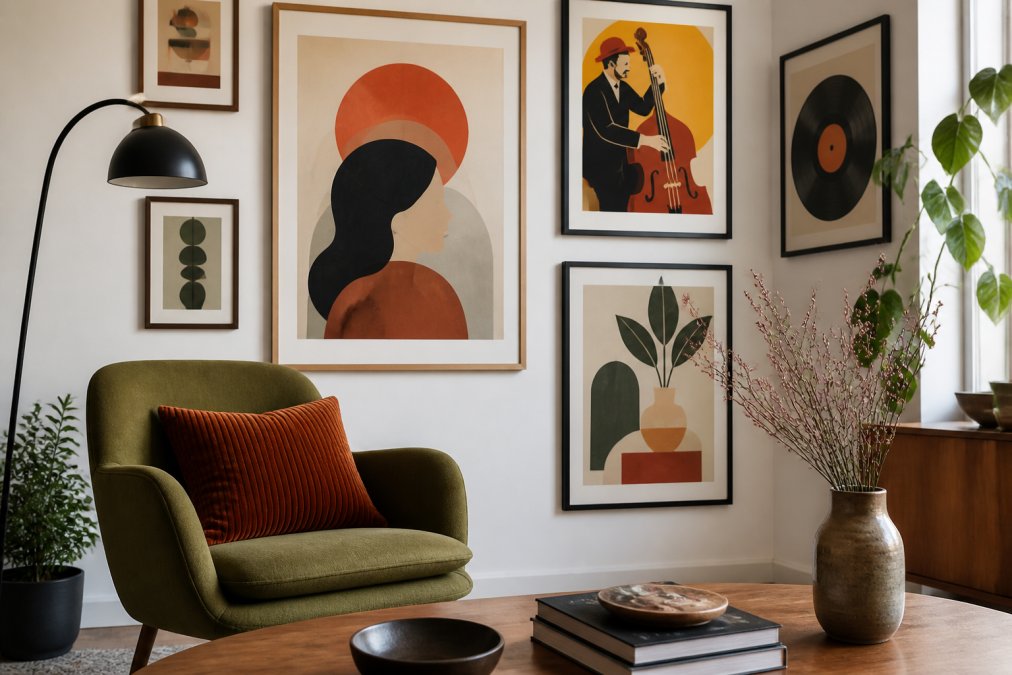
Gallery walls succeed by balancing visual weight across the entire composition. The most common mistake is treating each poster equally with same frame, spacing, and size.
Start with an anchor piece, your largest or most visually dominant poster positioned slightly off-center at eye level (around 145 cm from floor to center). Build outward, mixing sizes and frame styles. A large poster paired with three smaller prints creates dynamic interest. Vary frame finishes, matte black, natural wood, brushed metal, to add depth.

Space frames 5-8 cm apart for cohesion; more than 10 cm feels scattered. Stagger frames vertically, some centered at eye level, others slightly higher or lower, to guide the viewer’s eye. Rather than matching colors across all posters, create visual pathways. Position three posters with blue tones to form a triangle, creating intentional flow. Contrast is your friend: pair warm-toned pop culture art with cool-toned landscapes.
Frame selection determines whether your gallery wall feels curated or chaotic. Mix frame styles only when they share a visual thread, all thin profiles, all wood tones, all minimal ornamentation. Introduce variation through color and size, not through completely different aesthetic directions.
How to Frame Posters Professionally
Framing separates an impulse grab from a piece that anchors your decor. The frame is architecture for your art.
Choose frame material based on your poster’s visual weight. Lightweight prints work with thinner frames; larger pieces need substantial frames for visual balance. A mat protects your poster from touching glass and creates breathing room. A standard 5 cm mat works for most posters; wider mats (8-10 cm) suit gallery walls and larger pieces. Mat color should complement your poster’s dominant color or use neutral tones, white, cream, or soft gray.
UV-protective glass prevents fading, especially important for posters in sunny rooms. Standard glass works for low-light spaces. Acrylic is lighter but scratches easily. Anti-reflective glass reduces glare but shows dust more readily.
Cheap frames with thin backing allow moisture to seep behind your poster, causing warping, mold, and permanent damage within months. Invest in frames with solid backing and sealed edges, especially in humid rooms.
Professional framing costs more but is worth it for posters you genuinely value. Frame your most-displayed piece professionally and use simpler frames for supporting posters. One stunning centerpiece outperforms five mediocre frames.
Art Styles and Movements Trending in 2026
The wall art market shifts decisively away from stark minimalism toward warmth and texture. According to Wallfully’s 2026 analysis, homeowners crave spaces that feel intentional and connected to nature. Bold color palettes, burnt sienna, deep oranges, rich purples, replace cool grays and stark whites.
Pop culture characters remain dominant, particularly among Gen Z and millennials. Gaming posters, vintage movie artwork, and meme-inspired designs reflect a generation comfortable expressing personality through decor. The Modern Art Nouveau Revival blends organic, flowing lines with bold modern abstraction, botanical motifs reimagined through contemporary graphic design.
Oversized statement pieces anchor rooms more effectively than gallery walls. According to Posterscape’s 2026 wall art trends, single bold pieces now outperform multiple prints in visual impact. Personalization accelerates as the print-on-demand market in Canada reached CAD 572.7 million in 2025 and is projected to exceed CAD 3 billion by 2033. Mass-produced prints lose value as buyers want designs reflecting their specific interests.
Nature-inspired artwork remains consistently popular, but execution has evolved. Botanical prints rendered in jewel tones or metallics feel current; realistic nature photography feels dated.
Maintenance and Preservation of Wall Art
Your poster’s lifespan depends on protection. UV-protective glass is essential if your poster receives direct sunlight. Standard glass offers zero protection; UV rays fade colors within months in sunny rooms.
Humidity is the silent killer. Moisture causes paper to warp, ink to bleed, and mold to grow. In basements or bathrooms, sealed frames with moisture barriers are essential. Check frames quarterly in humid seasons.
Avoid hanging art directly above heating vents, radiators, or air conditioning units. Constant temperature swings cause paper to expand and contract, eventually cracking. Maintain stable room temperature between 18-24°C.
Clean with restraint. Never spray anything directly on your poster. Use a soft, dry microfiber cloth to wipe glass and frames. For stubborn dust, slightly dampen the cloth with distilled water, then immediately dry. Avoid commercial glass cleaners.
Store rolled posters flat or loosely rolled in acid-free tubes. Use acid-free tissue paper and archival boxes for long-term preservation. Never store in plastic bags; they trap moisture.
Rotate displayed posters seasonally if you have a collection. This distributes UV exposure evenly and prevents one poster from fading noticeably while others remain vibrant.
Unique Artistic Posters for Every Budget and Space
Finding unique artistic posters that fit your budget doesn’t mean compromising on quality or originality.
For budget-conscious buyers, Etsy Canada’s unique posters marketplace offers digital downloads, with prices varying by seller. McMullon Brands specializes in unique, whimsical designs celebrating pop culture. Their curated collection emphasizes original designs you won’t find mass-produced elsewhere, with free shipping.
Opposite Wall, designed in Montreal, offers minimalist and abstract wall art starting from CAD 14.95. JUNIQE offers over 200,000 designs from independent artists on high-quality semi-gloss paper. Displate Metal Posters offer a premium alternative, with prices varying. The National Gallery of Canada Boutique offers exclusive posters from the collection starting around CAD 6.95.
Small spaces demand strategic choices. A single large poster (60 by 90 cm) anchors a small bedroom more effectively than three small prints. Vertical posters work better in narrow hallways. Choose one statement piece over multiple smaller ones.
| Budget Level | Best For | Trade-offs |
|---|---|---|
| Ultra-budget | Digital downloads, small prints | DIY printing, limited framing options |
| Budget-friendly | Independent artist prints, unique designs | Variable quality between sellers |
| Mid-range | High-quality prints, customization | Longer shipping times possible |
| Premium | Metal prints, fine art reproductions, durability | Higher upfront cost, import fees possible |
Unique artistic posters transform ordinary walls into expressions of personality. Whether decorating a first apartment, refreshing a bedroom, or building a gallery wall, the right poster, thoughtfully framed, strategically placed, and properly maintained, becomes part of how you experience your home.
Canadians invest more in personalized wall art because they recognize its impact on how spaces feel. Your walls deserve better than generic prints. McMullon Brands helps you discover designs that feel authentically yours, with free shipping making unique art accessible. Start with one piece that genuinely speaks to you, frame it properly, and build from there. That’s how memorable spaces happen.
=== FAQ ANSWERS (audit these too, same rules) ===
[1] Q: How do you choose the right unique artistic posters for your home?
A: Start by identifying your personal aesthetic: do you prefer minimalist designs, bold pop culture references, or nature-inspired art? Consider your room’s color palette and existing decor. Choose posters that resonate emotionally with you rather than following trends alone. Think about the room’s purpose, energetic designs work well in creative spaces, while calming artwork suits bedrooms. Look for high-quality paper and professional printing to ensure your posters maintain their visual impact over time.
[2] Q: What are the best ways to display unique posters without damaging walls?
A: Use poster rails, picture ledges, or magnetic strips for damage-free installation. Adhesive strips rated for your wall type (drywall, plaster, or painted surfaces) offer a non-permanent solution. Frame your posters to protect them and add a finished look. If using nails, use appropriate anchors for your wall material and hang at eye level (145 cm from floor to center). Avoid direct sunlight to prevent fading, and maintain 5-8 cm of space between framed posters in a gallery wall for visual breathing room. For rental spaces, lean larger posters against walls or use freestanding easels as an alternative.
[3] Q: How do you mix and match different art styles in a gallery wall?
A: Create cohesion by choosing a unifying element: a consistent color palette, frame style, or theme. Mix artistic movements, such as pairing minimalist geometric designs with pop culture references, by keeping the overall arrangement balanced. Vary poster sizes to create visual interest, but maintain consistent spacing between frames. Limit your color palette to 3-4 primary colors to avoid visual chaos. Start with a focal point (your largest or most striking poster) and build around it. Sketch your layout on paper before hanging to ensure the composition feels intentional and inviting.
[4] Q: Why is wall art considered important for home design in 2026?
A: Wall art has become central to personal expression and mental well-being. Engagement with art and culture correlates with better mental health: 46% of Canadians who engage in arts activities two to three times monthly report excellent or very good mental health, compared to 35% who never engage. In 2026, there’s a dramatic shift toward warmth and texture in home design, with homeowners seeking spaces that feel intentional and deeply connected to nature. Unique artistic posters serve as affordable, accessible ways to achieve this emotional connection and create rooms that reflect individual identity.
Frequently Asked Questions
Q: How do you choose the right unique artistic posters for your home?
A: Start by identifying your personal aesthetic: do you prefer minimalist designs, bold pop culture references, or nature-inspired art? Consider your room's color palette and existing decor. Choose posters that resonate emotionally with you rather than following trends alone. Think about the room's purpose, energetic designs work well in creative spaces, while calming artwork suits bedrooms. Look for high-quality paper and professional printing to ensure your posters maintain their visual impact over time.
Q: What are the best ways to display unique posters without damaging walls?
A: Use poster rails, picture ledges, or magnetic strips for damage-free installation. Adhesive strips rated for your wall type (drywall, plaster, or painted surfaces) offer a non-permanent solution. Frame your posters to protect them and add a finished look. If using nails, use appropriate anchors for your wall material and hang at eye level (145 cm from floor to center). Avoid direct sunlight to prevent fading, and maintain 5-8 cm of space between framed posters in a gallery wall for visual breathing room. For rental spaces, lean larger posters against walls or use freestanding easels as an alternative.
Q: How do you mix and match different art styles in a gallery wall?
A: Create cohesion by choosing a unifying element: a consistent color palette, frame style, or theme. Mix artistic movements, such as pairing minimalist geometric designs with pop culture references, by keeping the overall arrangement balanced. Vary poster sizes to create visual interest, but maintain consistent spacing between frames. Limit your color palette to 3-4 primary colors to avoid visual chaos. Start with a focal point (your largest or most striking poster) and build around it. Sketch your layout on paper before hanging to ensure the composition feels intentional and inviting.
Q: Why is wall art considered important for home design in 2026?
A: Wall art has become central to personal expression and mental well-being. Engagement with art and culture correlates with better mental health: 46% of Canadians who engage in arts activities two to three times monthly report excellent or very good mental health, compared to 35% who never engage. In 2026, there's a dramatic shift toward warmth and texture in home design, with homeowners seeking spaces that feel intentional and deeply connected to nature. Unique artistic posters serve as affordable, accessible ways to achieve this emotional connection and create rooms that reflect individual identity.
This article was written using GrandRanker
Leave a Reply