
Table of Contents
- Minimalist Ways to Display Movie Posters: A 2026 Guide
- How to Hang Posters Without Damaging Walls
- Magnetic Poster Hangers for Clean, Minimalist Displays
- Framing Techniques That Preserve and Showcase
- Creating a Minimalist Gallery Wall Layout
- DIY and Budget-Friendly Display Options
- Storage Solutions for Valuable Posters
- Frequently Asked Questions
Last Updated: September 29, 2026
Minimalist Ways to Display Movie Posters: A 2026 Guide
Minimalist ways to display movie posters emphasize clean lines, intentional spacing, and design that lets the poster shine. The right display method transforms a simple poster into a focal point while protecting your investment.
This guide covers the most effective minimalist ways to display movie posters, from damage-free hanging solutions to gallery wall layouts that work in any room.
The shift toward minimalism in poster display reflects a broader design philosophy: Best of Signs 2026 analysis on minimalist poster design shows that clean layouts with a single key visual element boost visibility far more than cluttered arrangements. More importantly, minimalist displays protect your investment. A poster displayed correctly can last decades. Displayed carelessly, it fades, yellows, and deteriorates within months.
How to Hang Posters Without Damaging Walls
Choosing the wrong hanging method damages posters or walls. Renters especially need solutions that leave zero marks.
Damage-Free Hanging Solutions
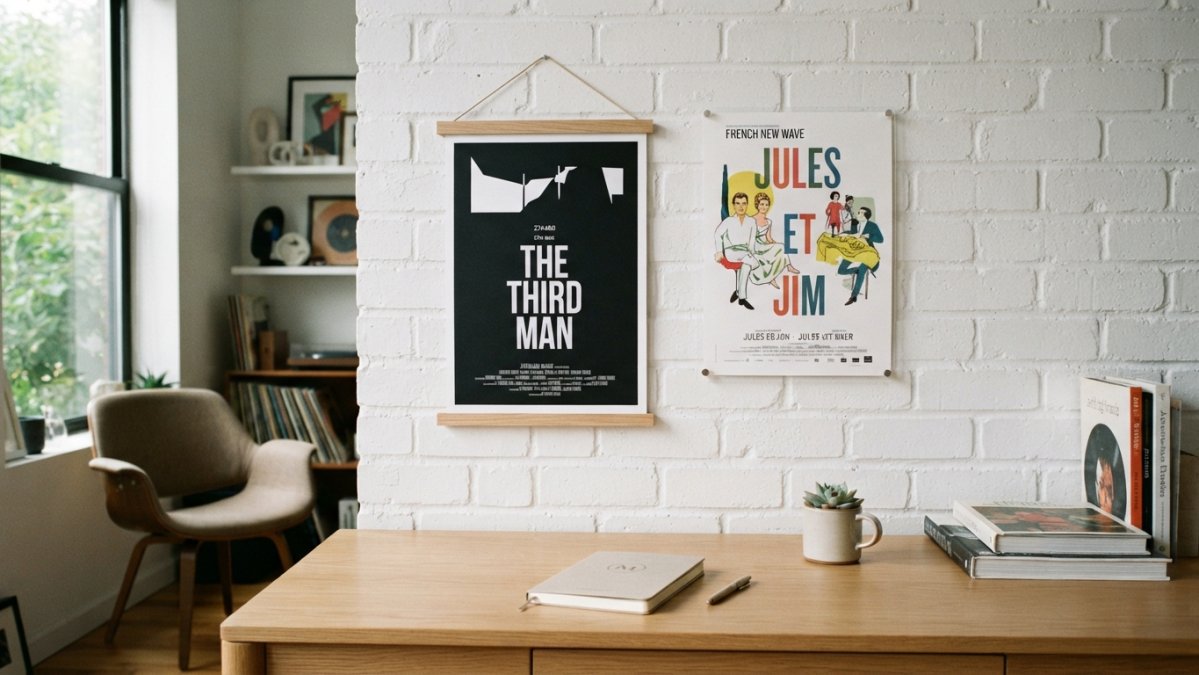
Magnetic poster hangers clamp the poster at top and bottom without punctures, allowing you to swap posters in seconds. For renters, this offers complete reversibility with no wall or poster damage.
Washi tape offers zero-damage mounting in dozens of colors, but works only for temporary displays and won’t preserve valuable posters long-term.
Command strips and adhesive hangers provide a middle ground, holding weight while peeling off cleanly on smooth walls.
Modern Memory Design’s 2026 guide on poster preservation methods emphasizes that damage-free solutions must account for both wall condition and poster weight. A lightweight poster on drywall tolerates adhesive strips. A heavier poster on textured walls needs magnetic rails or traditional hardware.
Magnetic Poster Hangers for Clean, Minimalist Displays
Magnetic poster hangers represent the gold standard for minimalist display, clamping the poster between wooden or metal rails to create a floating effect.
Rails at top and bottom hold the poster flat and taut. Most models use natural wood finishes that complement any décor. Magnetic hangers cost far less than framing while delivering a more sophisticated look than tape or clips.
Swapping artwork takes seconds with no tools or damage, making magnetic hangers ideal for collectors or seasonal refreshes. With Free Shipping on all orders and Products Made to Order, you can find options to match your space perfectly.
Magnetic systems don’t protect against dust or humidity, so they’re not ideal for valuable vintage posters, but work well for standard posters in climate-controlled rooms.
Framing Techniques That Preserve and Showcase
Framing transforms a poster into a protected, gallery-quality display. The right frame elevates the artwork while ensuring it survives decades of display.
Acid-Free Matting and Archival Quality
Acid-free matting is essential for preservation. Standard cardboard contains acid that yellows posters; acid-free matting prevents this deterioration.
The mat between poster and glass must be acid-free, lignin-free, and archival-quality. This is essential for valuable posters, determining whether they last 10 or 100 years.
Slim-profile frames in matte black, natural wood, or brushed metal recede visually, letting the poster dominate. Professional framing ensures proper mounting and protection.
UV Protection and Accent Lighting for Long-Term Display
UV light fades posters fastest. UV-protective glass or acrylic blocks 99% of harmful rays, extending vibrancy indefinitely.
Acrylic floating mounts sandwich the poster between clear sheets, creating a floating effect with UV protection. These deliver gallery-quality presentation.
Strategic Lighting for Minimalist Poster Displays
Accent lighting uses restraint to draw focus. Low-profile LED strips above or below a framed poster create a subtle halo effect, working especially well in darker rooms.
Warm white LEDs (2700K-3000K) enhance vintage posters; cool white LEDs (4000K-5000K) suit modern or sci-fi posters. Avoid daylight-temperature LEDs (6500K+) as they can feel clinical.
Mount strips 10-15 centimetres above the frame for uplighting, or along the bottom for dramatic effect. For gallery walls, light only the anchor piece to maintain minimalist restraint.
LED strips rated for 3000-5000 lumens are sufficient for most home displays; brighter strips designed for commercial use will overwhelm a minimalist aesthetic. Dimmable strips give you control over intensity throughout the day and evening. Most quality LED strips consume 5-10 watts and run cool enough to mount directly behind frames without risk of heat damage to the poster.
One practical consideration: if you’re renting or prefer not to install permanent wiring, battery-powered LED strips with remote controls offer the same visual effect without wall damage. These typically last 20-40 hours per charge, making them an accessible entry point to accent lighting.
Creating a Minimalist Gallery Wall Layout
A gallery wall displays multiple posters at different sizes and in different frames, unified by intentional spacing and alignment. Done well, it becomes a curated art collection. Done poorly, it looks chaotic.

The minimalist approach to gallery walls prioritizes negative space. Rather than filling every inch, leave breathing room between frames. This restraint makes each poster more impactful. A common layout uses a central anchor poster, your favourite or largest piece, with smaller posters arranged symmetrically around it. Alternatively, a linear arrangement along a single wall creates clean visual rhythm.
Planning Your Layout: The Template Method
Before hanging anything, create a full-scale template on the wall. This is the single most important step and the one most people skip. Measure your wall and sketch the layout on kraft paper or use painter’s tape to outline each frame’s position. This prevents crooked arrangements and reduces wall damage from trial-and-error hanging.
Start by identifying your anchor poster, the piece that will dominate visually. This is typically your largest poster or the one with the most visual weight. Position it at eye level (roughly 150-160 centimetres from the floor to the frame’s centre). This becomes your reference point.
For a symmetrical layout around the anchor, measure equal distances left and right. If your anchor is 60 centimetres wide and centred on a 240-centimetre wall, you have 90 centimetres of space on each side. Divide this space proportionally for smaller posters. A common pattern: anchor in the centre, two medium posters 25 centimetres to the left and right, then smaller posters filling the outer edges.
For a linear arrangement, space frames evenly along a single horizontal line. Spacing typically ranges from 5 to 10 centimetres between frame edges, tighter spacing (5 centimetres) creates visual cohesion, while wider spacing (10 centimetres) emphasizes individual pieces. Measure the total width of all frames plus spacing, then divide by the number of gaps to ensure even distribution.
Consistency and Frame Selection
Consistency matters. Choose frames in a unified colour palette: all black, all natural wood, or a mix of two complementary finishes. Vary the poster sizes but keep frame styles cohesive. This creates visual harmony while avoiding the “random collection” feel.
If mixing frame styles, establish a rule: perhaps all black frames with one natural wood accent, or all wood frames in the same finish family. Avoid mixing more than two frame colours; this fragments the visual field and undermines minimalism.
Frame width also affects the overall feel. Slim frames (2-3 centimetres) reinforce minimalism; wider frames (5+ centimetres) feel more traditional. Stick to one frame width throughout the gallery wall unless you’re deliberately creating a tiered effect (smaller frames with thinner borders, larger anchor with thicker border).
Handling Different Poster Sizes
When combining posters of different dimensions, standard 28 × 43 centimetre movie posters alongside smaller 20 × 30 centimetre prints, alignment becomes critical. The minimalist approach is to align frames by their top edges or centre lines, not their bottom edges. This creates visual order despite size variation.
For a mixed-size gallery, establish a horizontal baseline. All frame tops align at the same height, or all frame centres align at the same height. This single rule prevents the chaotic feeling that comes from random vertical placement.
If you’re combining posters with different aspect ratios (some portrait, some landscape), group similar orientations together.
Measurement and Installation
Use a level and measuring tape to mark hanging points. For each frame, measure the distance from the top of the frame to the hanging hardware (typically 5-8 centimetres). Mark this point on the wall with painter’s tape. Use a stud finder to locate wall studs if possible; hanging on studs ensures the wall can support the weight long-term.
DIY and Budget-Friendly Display Options
Not every minimalist display requires professional framing or expensive hardware. Several DIY approaches deliver impressive results without the price tag.
Storage Solutions for Valuable Posters
Collectors often display only a fraction of their collection. Proper storage protects posters you’re not currently showing.
Frequently Asked Questions
What is the best way to display movie posters in a minimalist style?
The best minimalist approach depends on your space and poster value. For temporary displays, magnetic poster hangers or washi tape mounting offer clean aesthetics without wall damage. For permanent collections, slim-profile frames with acid-free matting and UV-protective glass provide both protection and a sleek look. Digital frames are an increasingly popular 2026 trend, allowing you to cycle through high-resolution movie poster collections on a single screen, eliminating physical clutter while maintaining visual impact.
How do I hang posters without damaging walls?
Several damage-free methods work well: magnetic poster hangers clamp onto the top and bottom edges, requiring no wall punctures; washi tape (low-tack adhesive) holds posters safely and leaves no residue; adhesive strips rated for poster weight distribute pressure evenly; and acrylic floating mounts use standoff hardware that, while requiring drilling, protects both wall and poster. Choose based on your rental status and how long you plan to display the poster.
What are magnetic poster hangers, and are they truly minimalist?
Magnetic poster hangers are wooden or metal rails that clamp the poster’s top and bottom edges, suspending it between two mounting points. They’re minimalist because they eliminate the need for frames, glass, or matting. The simple design, often just natural wood or brushed metal, keeps visual focus on the poster itself. They’re ideal for renters since they require no wall damage, and you can swap posters instantly. They’re affordable and sustainable since you reuse the hardware.
How do I arrange multiple movie posters in a minimalist gallery wall?
Start with a consistent spacing rule (typically 5-8 cm between frames) and choose frames in one or two neutral tones to maintain visual cohesion. Arrange by visual balance rather than strict symmetry: vary frame widths slightly, and position the collection’s visual weight toward the center or upper third of the wall. Limit your palette to 3-4 poster themes to avoid clutter. Measure and mark all hanging points before installation to ensure alignment and reduce wall damage.
Leave a Reply