
Table of Contents
- Why Artisan Crafted Graphic Tees Are Taking Over 2026
- Trending Graphic T-Shirt Designs for 2026
- What Makes Handmade Graphic Tees Different
- The Rise of Minimal Graphic Shirt Design
- Print Techniques, Fabric, and Fit That Define Quality
- How to Style Graphic Tees for Any Occasion
- How to Spot Genuinely Artisan Crafted Apparel
- Conclusion
- Frequently Asked Questions
Last Updated: October 19, 2026
Why Artisan Crafted Graphic Tees Are Taking Over 2026
Artisan crafted graphic t-shirts are the antidote to a decade of disposable, algorithm-driven merch.
The trend coverage backs that up. Vexels’ 2026 print-on-demand trend report describes a hand-crafted look built on soft earthy colors, layered textures, and botanical or geometric motifs.
Below: the design directions worth watching, how to tell real artisan work from imitation, and how to style and care for these pieces so they last.
Trending Graphic T-Shirt Designs for 2026
The strongest trending graphic t-shirt designs for 2026 lean on nostalgia, texture, and typography rather than flat digital clip art.

Hand-Drawn Illustrations and Layered Textures
Hand-drawn illustration is where artisan crafted work separates itself fastest. Wobbly linework, visible brush texture, and imperfect edges read as human because they are human. Layer a botanical motif over a faded geometric shape for depth flat vector art cannot fake.
Nostalgia, Typography, and Statement Graphics
Nostalgia sells because it feels personal. UberPrints’ 2026 custom t-shirt trend list highlights handwritten fonts and doodle graphics among its top trends, alongside faded pastels and bold text. Varsity lettering, retro travel graphics, and hand-lettered statements all land in the same territory. The rule: pick one era and commit to it fully.
What Makes Handmade Graphic Tees Different
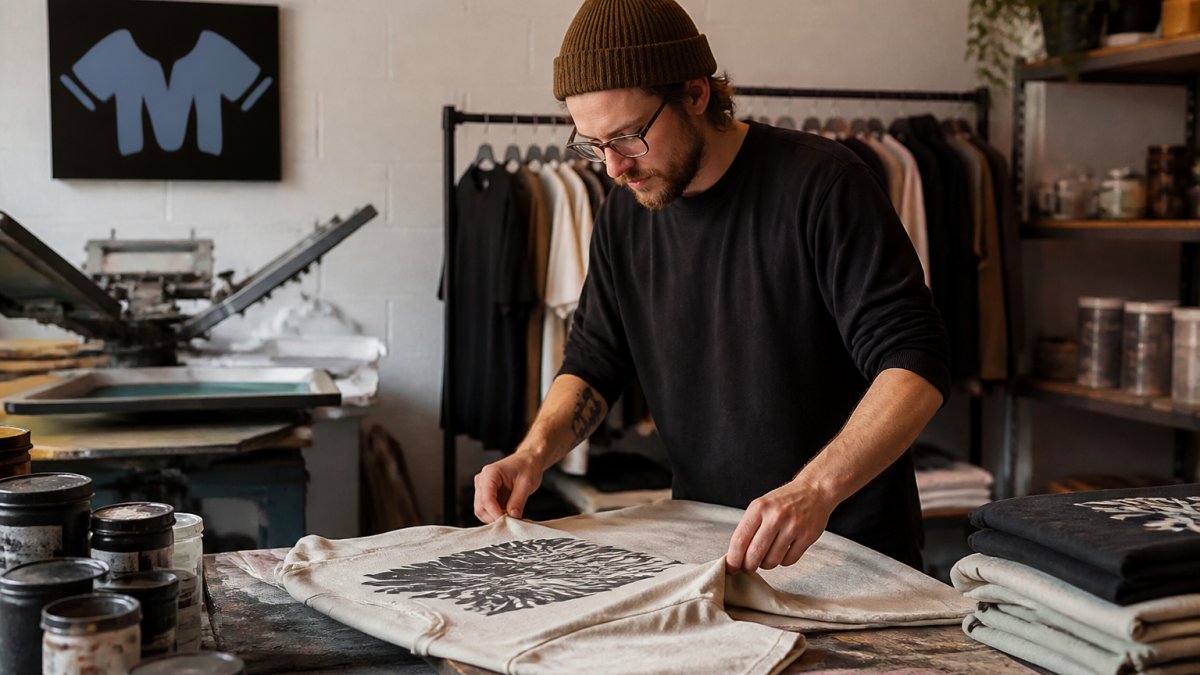
Handmade graphic tees differ from mass-produced shirts in three measurable ways: the artwork is original rather than licensed stock, the print run is small enough to inspect, and the garment is chosen for how it wears rather than for the lowest cost.
A common mistake is assuming “handmade” means rough. It usually means the opposite: small-batch producers check each print by hand, catching the registration errors and faded patches that slip through high-volume lines.
Ask any seller how large their print runs are. Small-batch producers can usually tell you the exact number of shirts in a drop. If the answer is vague or the design is clearly a licensed stock illustration, you are looking at mass production with artisan branding.
The Rise of Minimal Graphic Shirt Design
Minimal graphic shirt design is winning because it survives more than one season. A single line drawing, a small chest placement, or a two-color typographic mark reads as intentional rather than loud, and pairs with almost everything in a wardrobe.
This is where the artisan approach pays off most. Minimal designs live or die on execution: line weight, spacing, and print sharpness. A hand-drawn minimal mark has subtle variation a perfectly symmetrical vector lacks.
Print Techniques, Fabric, and Fit That Define Quality
Print technique, fabric weight, and garment construction decide whether a graphic tee survives twenty washes or fades by the fifth. Most shoppers evaluate the graphic and ignore the three variables underneath it. That is a mistake: the print method determines how the shirt ages, the fabric how it feels and drapes, and the construction whether it keeps its shape.
Print methods and how they age
Screen printing remains the standard for durable, opaque graphics on cotton, but not all screen printing behaves the same.
- Water-based inks sink into the cotton fibers rather than sitting on top. The result is a soft hand-feel and a print that fades gradually and evenly, which many artisan makers treat as a feature rather than a defect. Because the ink bonds with the fiber, it is less prone to the sharp cracking that plagues heavy plastisol prints.
- Plastisol inks sit on the surface of the fabric and hold crisp, saturated color. They are the workhorse of high-volume production, but a thick plastisol layer can crack along fold lines if it is under-cured or applied too heavily. A well-cured, thin plastisol print is durable; a thick one is not.
- Discharge printing removes dye from the garment and replaces it with pigment, producing a very soft print with no hand-feel. It only works reliably on garment-dyed cotton, which is why it shows up in small-batch and vintage-style lines.
Small-batch makers often choose the method per design: water-based or discharge for soft, textured illustration, plastisol for bold, high-contrast graphics, and DTG for one-off or highly detailed artwork. Ask which method was used and you will learn a lot about how the shirt will age.
Fabric and texture
Fabric matters just as much as the print. Slub cotton has a visible, irregular texture that suits hand-drawn illustration because the fabric itself reads as handmade. Ringspun cotton feels smoother and takes fine detail well. Heavier fabric (measured in grams per square meter, or GSM) holds a boxy shape and resists transparency; lighter fabric drapes more but can cling and show print-through.
Fit and construction checklist
Fit is the third leg. A boxy, dropped-shoulder cut flatters layered graphics; a fitted cut suits minimal chest prints. Check construction, not just the size chart:
- Shoulder seams: reinforced or taped shoulder seams resist stretching and keep the shirt’s shape.
- Side seams: a shirt with side seams can be tapered or altered; a tubular body (no side seams) is cheaper to produce and less shape-retentive.
- Hem and collar: a ribbed collar with a reinforced neckband holds its shape; a thin, single-stitch collar tends to stretch out first.
| Element | What to Look For | Why It Matters |
|---|---|---|
| Print method | Screen print (water-based, discharge, or thin plastisol) or DTG | Determines softness, fading pattern, and cracking risk |
| Fabric | Slub or ringspun cotton; note the GSM weight | Texture suits hand-drawn art; weight affects drape and opacity |
| Construction | Reinforced shoulder seams, ribbed collar, side seams | Keeps shape over time |
| Fit | Boxy or fitted, stated clearly with flat measurements | Affects how the graphic reads |
| Shrinkage | Pre-shrunk or stated shrinkage allowance | Prevents a size surprise after the first wash |
Before you buy, ask the maker three things: which print method was used, what the fabric weight is, and whether the garment is pre-shrunk. A small-batch producer can usually answer all three from memory. Vague answers are a signal.
Care and durability by print method
The care routine should follow the print, not the other way around. Rules most makers agree on:
- Wash cold and inside out. Heat is the enemy of every print method; cold water and a gentle cycle slow fading and reduce cracking.
- Skip the dryer or use low heat. High dryer heat accelerates plastisol cracking and shrinks cotton. Air-drying preserves both the print and the fit.
- Avoid fabric softener on printed areas. It can leave a residue that dulls the print and reduces the ink’s bond over time.
Water-based and discharge prints soften and fade gradually, which is expected; plastisol prints should stay crisp if cared for, and visible cracking usually signals under-curing or dryer heat. DTG prints benefit most from cold washing and air-drying because the white underbase degrades first.
How to Style Graphic Tees for Any Occasion
Styling a graphic tee comes down to letting the shirt lead, but artisan pieces give you more to work with than a mass-produced graphic. Print scale, placement, fabric weight, and the hand-drawn quality of the artwork all change how a tee reads in an outfit. Style the specific print in front of you.
Read the print before you build the outfit
- Print scale: a large back or full-front print wants a quieter bottom half. A small chest print or a single-line mark can carry more texture and layering elsewhere.
- Placement: center-chest prints read as classic and pair well with tailoring; off-center or back prints read as streetwear and suit relaxed, oversized silhouettes.
- Fabric weight: a heavier, boxy tee holds a structured shape and works tucked or half-tucked; a lighter, draped tee works untucked and layered.
Outfit formulas that respect the print
- Casual style: boxy tee, straight-leg jeans, plain sneakers. Keep the denim a solid wash so the print stays the focal point.
- Smart casual: a fitted minimal tee under a blazer with chinos. A small chest print or tonal linework works best here; a large back print is hidden by the jacket and wasted.
- Layered: a long-sleeve graphic under an open overshirt or chore coat. Match fabric weights so the sleeve does not bunch under the outer layer.
Do not stack a loud graphic with a loud pattern. The two compete and both lose. Let the printed design carry the outfit and keep everything else neutral. The same rule applies to print placement: one focal print per outfit is enough.
Styling for longevity
How you wear a tee affects how long it lasts. Repeated collar stretching, tight layering that abrades the print, and heavy bags on the same shoulder all shorten a shirt’s life. Rotate artisan pieces rather than wearing one daily, and store them folded. A shirt you style carefully is also one you wash less often, the single biggest factor in print longevity.
Style the print, not just the tee. Scale, placement, and fabric weight tell you which outfit formula will work, and wearing the shirt with care is part of getting value from an artisan piece.
How to Spot Genuinely Artisan Crafted Apparel
Genuinely artisan crafted apparel shows evidence of human decision-making at every stage: original artwork, a small production run, and a maker who can explain the print method.
Start with the artwork. Original illustration has small inconsistencies: a line that thickens slightly, a color that shifts a shade. Ask who made it.
Check the garment too: slub fabric and reinforced seams cost more, and artisan producers tend to use them. Finally, look at the shop’s history and reviews.
Three questions separate real artisan work from imitation: Who drew it? How was it printed? How many were made? If a seller cannot answer all three, the “handmade” label is marketing.
Conclusion
The hardest part of buying artisan crafted graphic t-shirts is not finding them, it is telling the real ones from the imitations. McMullon Brands offers a curated collection of unique, high-quality products infused with whimsy and personality. We are dedicated to delivering joy directly to your doorstep with the added benefit of free shipping on our creative goods.
Start with one shirt you genuinely love the artwork on, and see how it wears.
Frequently Asked Questions
What makes a graphic t-shirt artisan crafted?
An artisan crafted tee starts with original artwork, often hand-drawn or hand-painted rather than pulled from a stock library. The printing is usually done in small batches, which allows for closer attention to detail and color accuracy. Materials tend to be chosen deliberately, such as heavier cotton or slub fabric with visible texture. You can look for signs like slight variations between pieces, hand-numbered runs, or a maker who can explain the design process. These details separate artisan crafted apparel from mass-produced graphic tees.
How can you tell if a graphic tee is high quality?
Check three things: the fabric, the print, and the construction. A quality tee uses cotton with a substantial weight and a smooth or intentionally textured hand feel. The print should be sharp, evenly applied, and bonded well to the fabric, with no cracking or peeling at the edges when stretched gently. Look at the seams and hem for even stitching and reinforced shoulders. Washing instructions matter too; hand-printed designs often last longer with cold washes and air drying, which is a sign the maker expects the piece to endure.
How do you style a graphic t-shirt for work or a casual outing?
For a smart-casual look, tuck a minimal graphic shirt design into tailored trousers or a midi skirt and add a blazer. Choose tees with smaller, centered graphics for office settings and save bold statement prints for weekends. For casual outings, pair an oversized graphic tee with straight-leg jeans and sneakers, or knot it at the waist with high-waisted shorts. Layering under an open button-down or a denim jacket works well in cooler months. The key is balancing one loud piece with quieter surrounding items.
Which graphic t-shirt designs are trending in 2026?
The 2026 trend reports point to several directions: hand-crafted visuals with soft earthy colors and botanical or geometric motifs, nostalgic graphics including bubble lettering and varsity styles, handwritten fonts with doodle graphics, and minimalist text designs. Retro bootleg photo shirts and vintage-inspired prints also appear in trend roundups. Faded pastels, bold text, and celestial themes show up across multiple sources. Many of these trends favor an artisan crafted approach, where the design feels personal rather than mass-produced, which is why small-batch printed tees are gaining attention.
Ready to find a graphic tee that actually feels like yours? Browse the McMullon Brands collection and get free shipping on every order.
Leave a Reply