
Table of Contents
- Why Posters Curl in Humid Rooms
- How to Stop Posters From Curling: Measure Humidity First
- Protecting Wall Art From Moisture and Humidity
- How to Flatten a Curled Poster Safely
- How to Store Posters Without Bending or Curling
- When to Call a Conservator or Replace the Print
- Conclusion
- Frequently Asked Questions
Last Updated: October 20, 2026
Why Posters Curl in Humid Rooms
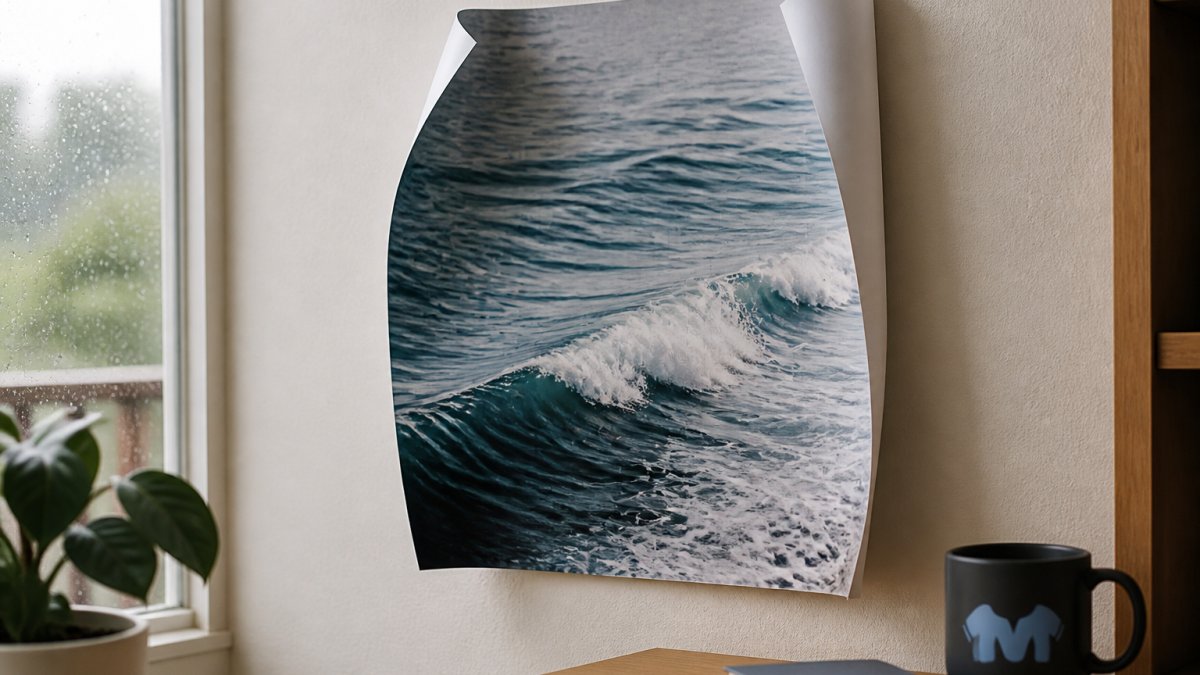
Paper is a sponge. It pulls moisture from the air, swells, and then dries unevenly. That uneven swell and shrink is what causes poster curling, and it explains why poster curling can turn a print that hung flat all winter into a rippled sheet by July.
Here is the part most people miss. A framed poster is not sealed from the room. Air moves through the frame back, around the glazing, and into the paper itself. McMullon Brands prints posters on paper stock that behaves like any other print: it responds to the room around it. The front face sits against glass. The back faces open air. One side absorbs moisture faster than the other, and the paper cups toward the drier side.
Three forces drive the curl:
- Humidity swings. Paper fibers expand as relative humidity rises and contract as it falls.
- Uneven exposure. A bathroom wall, a kitchen, or a spot above a radiator hits one face harder.
- Poor support. A poster taped at the top corners has nothing holding the bottom flat.
Fix the cause, not the symptom, and the curl stays gone.
How to Stop Posters From Curling: Measure Humidity First
You cannot control what you have not measured. Buy an inexpensive hygrometer (a small digital humidity gauge) and place it near the poster for a few days.
Relative humidity is the amount of water vapor in the air compared with the maximum the air could hold at that temperature, shown as a percentage. It is the number that matters for paper.
Target Humidity Ranges for Paper and Prints
Most paper-based artwork does best in a stable range of roughly 40-50% relative humidity. Below 30% the air is dry enough to make paper brittle. Above 60% you are inviting mold, condensation on glass, and persistent warping.
The key word is stable. A room that swings from 35% to 65% every day stresses paper more than a steady 55%. Aim for consistency first, then nudge the number into range.
Quick checks before you buy anything:
- Read the hygrometer in the morning and evening for three days
- Note any spike after showers, cooking, or laundry
- Check whether the poster sits near a vent, window, or exterior wall
- Look for condensation on the inside of the glass
If condensation appears on the room side of the glass, the air inside the frame is colder than the room. That trapped moisture is the real problem, not the poster.
Step-by-Step Diagnosis: Find the Cause Before You Fix It
Work through this in order. Each step points to a different fix.
- Check the gauge. If relative humidity sits above 60%, the room is the cause. Move to humidity control.
- Check the mounting. Lift the frame off its hook. If the poster is taped or pinned at the top only, poor support is at least part of the problem.
- Check the back. A bare cardboard or hardboard backing passes moisture straight through. Look for a sealed or acid-free back.
- Check the location. A wall shared with a bathroom or an exterior wall holds more moisture than an interior wall.
- Check the paper. Thin poster paper curls faster than heavy matte stock. Glossy photo paper can cockle from surface moisture alone.
That last point deserves a closer look. Different papers react differently. Thin, uncoated poster stock absorbs moisture quickly and warps fast. Heavier matte papers resist better. Glossy photo prints can show small ripples, called cockling, even when the sheet stays mostly flat. If your print is a photographic or fine-art reproduction, treat it more gently than a mass-printed poster.
Protecting Wall Art From Moisture and Humidity
The best protection is a frame built to keep damp air off the paper. That means a sealed back, a mat, and materials that will not off-gas or transfer acid into the print.
Start with the room:
- Run a dehumidifier in damp months and empty it regularly
- Use exhaust fans during showers and cooking
- Keep posters off exterior walls and away from bathroom doors
- Avoid hanging art directly above radiators or in direct sunlight
- Leave a small gap between the frame and the wall so air can move behind it
Direct sunlight does double duty as a threat: it fades inks and it heats the glass, which can drive condensation inside the frame. A window-facing wall is the worst spot for a print you care about.
Framing Materials and Construction That Block Damp Air
A frame is a small climate box. Build it well and the paper barely notices the room.
| Component | What to Use | Why It Matters |
|---|---|---|
| Glazing | Acrylic or glass with a small air gap | Keeps room air off the print |
| Mat | Acid-free mat board | Stops the art touching the glazing |
| Backing | Acid-free foam board | Blocks moisture from behind |
| Seal | Frame sealing tape on the back | Cuts air exchange |
| Hanging | Two hooks or a French cleat | Keeps the frame flat and level |
The mat does more than look good. It holds the poster away from the glazing so condensation forms on the glass, not on the print. A sealed frame with taped backing limits how much room air reaches the paper. A dry mounting service can bond a stubborn print to acid-free board for a permanently flat result, but it is permanent, so save it for prints you will never resell.
How to Flatten a Curled Poster Safely
Most guides give you one method, weight and wait, and leave it there. That is fine for a cheap reprint and risky for anything signed. The right approach depends on what the poster is made of and what it is worth, so start by sorting your print into one of three risk tiers before you touch it.
Tier 1: Low-risk prints (mass-produced, uncoated, under about $50 CAD to replace)
These tolerate gentle home flattening. The weight-and-wait method works because the paper is thin and the ink is not fragile.
- Acclimate first. Lay the poster flat, printed side up, in the room where it will hang for 24 hours. Moving it straight from a damp hallway to a dry press causes the surface to dry faster than the core, which is how you get cockling.
- Sandwich it. Place the poster between two clean sheets of acid-free board or plain white paper. Never use newsprint, the ink transfers.
- Add even weight. Stack flat, heavy books across the whole surface, not just the corners. Uneven weight presses new waves into the sheet.
- Wait three to seven days. Thin uncoated stock responds in about three days; heavier matte stock needs a week.
- Check and repeat. If curl remains, re-stack and wait longer rather than adding heat.
Tier 2: Medium-risk prints (coated, glossy, or photographic reproductions)
Glossy and photo papers have a coated surface that can cockle, small ripples, from surface moisture alone, even when the sheet stays mostly flat. Do not iron these. Heat can melt or cloud the coating, and the damage is permanent.
- Flatten only under weight, never with heat.
- Keep the print between acid-free board, not plastic, so any residual moisture can escape rather than condense.
- Give it a full week. Coated papers relax more slowly than uncoated stock.
- If ripples persist after two weeks under weight, the coating has likely taken a set. Stop and consider professional help.
Tier 3: High-risk prints (signed, numbered, vintage, or sentimental)
Do not flatten these yourself. Weight can crack flaking ink, and any moisture you introduce can start mold in the paper core. A paper conservator can humidify and flatten under controlled tension, a process that reverses curl without stressing the sheet. The cost of a consultation is almost always less than the value lost to a home fix gone wrong.
The iron question
An iron on the lowest setting, over a towel, kept off the printed side, can relax a stubborn uncoated poster. But heat and moisture together are what warped the paper in the first place. Use it only on Tier 1 prints, keep the iron moving, and never let it sit. If the print is glossy, valuable, or already showing cracks, skip the iron entirely.

Never iron a glossy photo print directly. The coating can melt and stick to the iron, and the damage is permanent.
How to Store Posters Without Bending or Curling
Storage is where most posters quietly ruin themselves. A rolled poster left in a hot attic or a damp basement will take a set that no amount of weighting will fix.
- Store flat in a wide, rigid portfolio or between acid-free boards
- If you must roll, roll face-out around a wide tube, never tight
- Keep storage in the same stable humidity range as display
- Avoid plastic bags that trap condensation
- Keep boxes off concrete floors and away from exterior walls
- Label and rotate: check stored prints every few months
A common mistake is storing rolled posters upright in a corner. The bottom edge takes the weight, and the roll flattens on one side. Lay them flat or store tubes horizontally.
When to Call a Conservator or Replace the Print
Some damage is beyond home fixes. Call a paper conservator if you see mold, foxing (brown spots), tide lines from water, flaking ink, or a print that stays curled after weeks of proper flattening.
Signs it is time for professional help:
- Visible mold or a musty smell
- Stains that spread or darken
- Cracks or flaking in the printed surface
- A print that will not flatten after two weeks under weight
- Any piece with sentimental or resale value
For an inexpensive poster, replacement is often the smarter call. For a signed print or original art, a conservator can stabilize damage that a home fix would make worse. The same logic applies to your framing budget: spend on the frame for the prints you love, and keep the cheap ones simple.
Conclusion
Humidity is patient. It will win against a taped poster on a bathroom wall every time, so give your prints a fighting chance with a gauge, a sealed frame, and a stable room. If you are starting fresh, our posters at McMullon Brands are printed to order and ship free, so you can build the display around a print you actually want to protect. Reach out with any questions and we will help you pick the right piece for your wall.
Frequently Asked Questions
Why do posters curl in humid rooms?
Paper absorbs moisture from the air, and the printed side often absorbs it at a different rate than the back. That uneven swelling makes one face expand more than the other, so the sheet bows and curls. Bathrooms, basements and kitchens with poor ventilation are the worst offenders because damp air lingers. Photographic prints and coated papers react faster than plain matte stock, and a poster hung near a window or exterior wall picks up condensation swings throughout the day.
Does framing a poster prevent it from curling?
A well-built frame slows curling but does not stop it on its own. Use a mat board so the print never touches the glazing, add an acid-free backing board, and seal the back with framing tape to limit damp air getting in. Avoid hanging the frame on an exterior wall or directly above a radiator. If the room stays above roughly 60% relative humidity for long stretches, run a dehumidifier alongside the frame rather than relying on the frame alone.
Will a dehumidifier help stop posters from curling?
Yes, if the room is genuinely damp. A hygrometer will tell you whether humidity is the culprit before you spend money. Aim to hold the room between 40% and 55% relative humidity, and empty the dehumidifier tank regularly so it keeps running. Keep the unit a metre or so away from framed art so it pulls moisture from the air rather than blasting dry air at the print, and check readings after a week to confirm the fix is working.
How can I flatten a poster that has already curled?
Start with the gentlest method. Lay the poster face up between two sheets of clean acid-free paper on a flat surface, then stack evenly distributed weight such as books across the whole sheet, not just the corners. Leave it for three to seven days in a dry room. For stubborn rolls, a framer may offer specialized flattening services, but these are permanent and only suit posters of low value. Never iron a poster directly or apply heat yourself.
Leave a Reply